
Updates to Medicaid and other developments affecting Northwest Washington
Throughout 2025, we have all read headlines about major policy changes shaping the future of healthcare, including those affecting Medicaid, the program that funds healthcare for approximately 70.5 million Americans nationwide – about one in five people. Here in Washington state, Medicaid is known as Apple Health, and it pays for medical and behavioral healthcare for nearly two million people across the state.
Policy changes can be complex, but their impact is personal. We’re closely tracking developments related to evolving funding and legislation, and we’re committed to sharing timely information about what these decisions mean for community behavioral health providers like us and the people we serve.
We will keep this page updated as much as possible, so check back often. If you’d like to learn more or support our advocacy efforts, please sign up for our newsletter or consider making a donation.
We appreciate you helping us amplify this information on social media, too – visit us on Facebook, Instagram, and LinkedIn.
Key Policy Areas We're Tracking
Medicaid
Medicaid is the program that funds healthcare for approximately 70.5 million Americans nationwide – about one in five people. Here in Washington state, Medicaid is known as Apple Health, and it pays for medical and behavioral healthcare for nearly two million people across the state.
What is happening to behavioral health funding in Washington state?
In the 2025 legislative session, Washington State lawmakers voted to lower our state’s Medicaid / Apple Health budget for community behavioral health. Starting in January 2026, Managed Care Organizations – the insurance companies that administer Medicaid / Apple Health and are contracted by the Washington State Health Care Authority (HCA) – will receive a one percent rate cut. This may affect the amount they reimburse us for the care we provide. The Managed Care Organizations in Washington State are Amerigroup, Community Health Plan of Washington (CHPW), Coordinated Care, Molina Healthcare, and UnitedHealthcare.
Even though one percent may sound like a small reduction, in reality it creates a big impact on our ability to operate sustainably. We still face rising expenses every year. Just like the cost of gas or groceries continues to go up, so do our costs for things like insurance, staff compensation, supplies and other expenses.
As a result, even small budget cuts result in significant financial losses for Compass Health and other community behavioral health providers, which limit our ability to maintain access to care.
U.S. Congress has time to prevent the worst impacts to Medicaid – but work must begin now.
There is still time to act.

How do Medicaid changes affect Compass Health and our clients?
Many of the services that Compass Health provides are funded through Medicaid / Apple Health insurance benefits. When state or federal lawmakers change the way Medicaid works or is funded, it leads to big impacts on providers like us and the people we serve.
For example, reductions in Medicaid funding mean that we may be forced to close or limit certain programs – even if they are vital to the community or demonstrate positive outcomes for clients. When individuals lose their Medicaid / Apple Health benefits because of requirements to reapply frequently or to meet certain standards, they also lose access to behavioral health and medical care. As a result, their conditions may deteriorate, limiting their ability to remain housed, employed and pursue their goals for recovery and community.
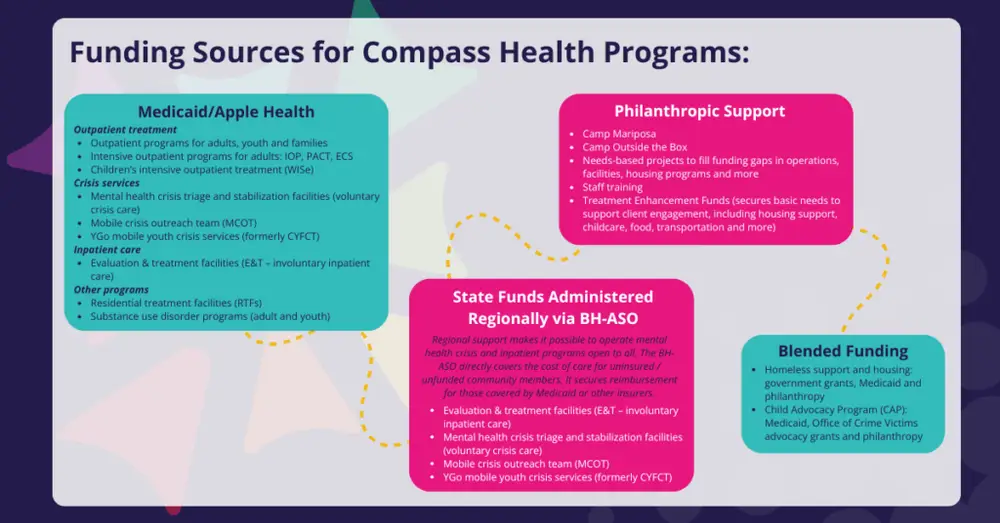
How are federal changes to Medicaid affecting people in Washington state?
Today, our team members help clients and community members complete their Medicaid eligibility verification. New, expanded Medicaid work requirements and more frequent eligibility verification will add a significant administrative burden – forcing us to add staff focused on paperwork, not client care.
For many vulnerable individuals, it is especially tough to track paperwork; these requirements are designed to exclude the very people who need help achieving recovery.
Children are particularly at risk, with 800,000 children statewide covered by Medicaid. In 26 of 39 counties across our state, over half of children rely on Medicaid.
How do Medicaid changes affect local law enforcement and emergency response?
Limiting access to preventive, sustainable and effective mental health and substance use disorder (SUD) services like the ones that Compass Health offers places pressure on – and adds costs to – other response systems, including emergency services and law enforcement.
When individuals cannot access crisis care, outpatient therapy, intensive behavioral health programs and other preventive services, their conditions can worsen, leading them to seek care in the emergency department or locations that are not equipped to provide optimal care. Worse, individuals may be unnecessarily incarcerated.
This leads to poor outcomes for the individual and greater costs for our communities.
What is Compass Health doing to advocate for access to Medicaid?
Compass Health is strongly committed to advocating for access to behavioral health care through critical programs like Medicaid / Apple Health – and through other important funding sources. We meet regularly with lawmakers and collaborate with other behavioral health agencies through Fourfront Contributor and the Washington Council for Behavioral Health. We will continue to speak out wherever we can to raise awareness of key issues.
SNAP Benefits
What’s the current situation with SNAP funding and how is it affecting Washington residents?
Over the past several weeks, concerns have grown about continued funding for the Supplemental Nutrition Assistance Program (SNAP). While steps have been taken to restore benefits, there is still uncertainty surrounding the stability of the program, which provides essential food support to families and individuals across the U.S.
The implications of this instability are far-reaching. Nearly one million Washington state residents rely on SNAP. That number includes Compass Health clients; 13 percent of individuals who completed assessments this year indicated that they struggled with food insecurity. In addition, nearly half of Compass Health clients fall within the income qualifications for SNAP.
This uncertainty affects our team and our neighbors as well. We know that it’s a stressful time for many, and we’re raising our voices at every opportunity to advocate for sustained, reliable access to food assistance. It’s a basic human right to have one’s essential needs met – and how can anyone focus on caring for their mental health when they are facing the stress of an empty pantry or skipped meals?
Local food banks have undoubtedly felt the impact of recent funding challenges and the increased demand that has followed. Yet they continue to work tirelessly to keep their shelves stocked, while local, community-driven initiatives are stepping up to fill the gaps and support those most affected.
Having trouble getting SNAP and other benefits right now?
If you or your family are affected by a delay or reduction in SNAP benefits, call 2-1-1 or visit their website. Resources are available to ensure that no Washington resident goes without the food and support they need.